
The most expensive AI mistake of 2026 wasn't a bad model or a security breach. It was the absence of a single safeguard most businesses still don't have — and the version that's quietly costing your firm is already running.


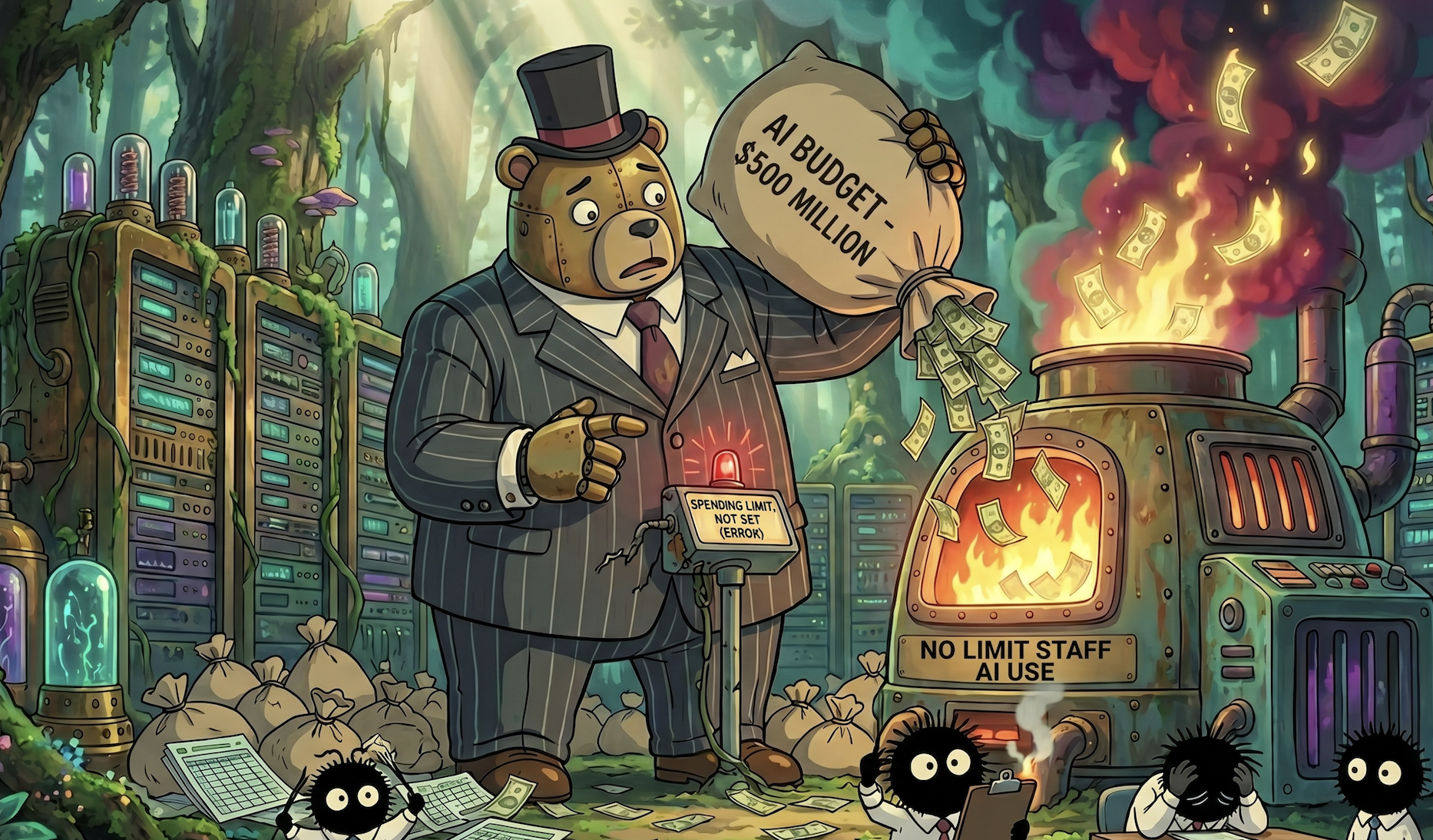
Via Axios: AI spending and ROI: Enterprise costs are spiraling
On May 28, 2026, Axios reporter Madison Mills published a detail that stopped finance teams across corporate America. An AI consultant told Axios that one of their clients recently spent half a billion dollars in a single month after failing to put usage limits on Claude licenses for employees.
Half a billion dollars. In thirty days. On AI.
The company has not been publicly named, and the figure comes from the consultant's account to Axios rather than a company disclosure — a caveat worth keeping in mind. But the mechanism behind it is not in dispute, and that is the part every business owner should pay attention to.
According to the reporting, the organization gave employees access to Claude through the provider's API with no spending caps, no token limits, and no usage restrictions. Enthusiastic adoption did the rest. The consultant explained that unrestricted access across the entire organization triggered explosive token consumption — thousands of employees running increasingly sophisticated, increasingly expensive AI tasks, with nothing in place to slow the burn.
The trap was structural, not stupid. Most businesses are conditioned by decades of software pricing to think in flat monthly seat fees — a predictable line on the budget. Advanced AI doesn't work that way. It is billed by consumption: every prompt, every document, every autonomous "agent" running in the background draws down tokens, and tokens cost money.
The math is unforgiving at scale. As Memeburn noted in its analysis of the incident, reports suggest the enterprise customer was likely using the provider's most expensive model, where output is priced at a steep premium per million tokens — meaning a relatively small number of heavy, automated workflows can compound into staggering sums.
And this is where the story stops being about one anonymous giant and starts being about everyone else.

The same Axios report placed the $500 million bill inside a much broader pattern. The enterprise is undergoing what one industry CEO described to Axios as a "healthy swing" away from AI overuse — what's being called "tokenmaxxing," the push to burn as many AI tokens as possible.
The examples piled up quickly. Major technology firms have begun pulling back: reporting indicates Microsoft has been cancelling much of its internal Claude Code usage, and other large companies reportedly exhausted their entire 2026 AI budgets months ahead of schedule. One detail from the Axios reporting captures the waste better than any number: a chief technology officer told Axios that employees at their company were using AI models to check the weather — something they obviously don't need AI to do.
The deeper diagnosis came from a former chief AI officer. Velastegui Ventures CEO and former Microsoft chief AI officer Sophia Velastegui suggested that one explanation for spiraling AI costs is that "most people default to automating tasks they dislike rather than tasks most valuable to the company."
Read that twice. The cost problem and the value problem are the same problem. Money flows toward whatever employees find annoying — not toward what the business actually needs. Without governance, AI doesn't optimize your operations. It subsidizes everyone's personal preferences, at a metered rate.
"An AI consultant tells Axios one of their clients recently spent half a billion dollars in a single month after failing to put usage limits on Claude licenses for employees." — Axios, May 28, 2026
Your firm is not going to ring up a $500 million bill. You don't have thousands of employees or an enterprise API contract. So it's tempting to file this under "billionaire problems" and move on.
That would be the mistake.
The disease that produced the half-billion-dollar headline — unmonitored, ungoverned, unmeasured AI use — does not require an enterprise to take hold. In a 20-person firm it looks different and smaller, but it is arguably more dangerous, because there is no finance department auditing token usage and no one whose job is to notice.
It looks like this:
The enterprise in the Axios story at least got a bill that forced the conversation. Most small and mid-sized firms never get that wake-up call. The cost shows up instead as leaked confidential data, a compliance exposure, or money spent on tools that never moved a single number that matters.
The encouraging part of the Axios reporting is that the correction is already underway, and it's not complicated. Finance departments are auditing token usage, AI access is being restricted by role, teams are being told to reuse outputs rather than repeatedly generate new prompts, and some firms are setting hard limits on monthly AI spending for the first time. The reporting also noted that some companies cut their costs dramatically once basic controls were introduced.
In other words: the fix is governance. Knowing what AI is being used, by whom, on what data, at what cost, toward what result. The enterprises that are winning in 2026 are not the ones using the most AI — they're the ones managing it most deliberately.
That discipline is exactly what most small and mid-sized firms have never set up, because no one inside the business owns it.
This is the specific problem AgentsROI.ai exists to solve for small and mid-sized businesses — before it shows up as a leaked file, a compliance headache, or wasted spend rather than a dramatic invoice.
A Shadow-AI Risk Assessment & AI Governance Audit gives an owner-led firm the visibility the $500 million company never had:
You don't need a half-billion-dollar mistake to justify thirty minutes of visibility into what your business is already exposed to.
The company in the Axios story didn't lack talent or ambition. It lacked a single thing: someone watching the meter.
If you can't currently answer "what AI is my team using, what data is it touching, and what is it costing me?" — you have the same gap, just at a scale that hasn't sent you a bill yet.
Book a Shadow-AI Risk Assessment and find out what's running inside your business before it becomes a problem you can measure.
This article references reporting by Axios (May 28, 2026) and subsequent coverage by Fast Company, Futurism, Tom's Hardware, Memeburn, and Tech Startups. The $500 million figure is based on an AI consultant's account to Axios and has not been confirmed by any named company. This content is for general informational purposes and does not constitute legal, financial, or compliance advice; consult a qualified professional regarding your specific obligations.