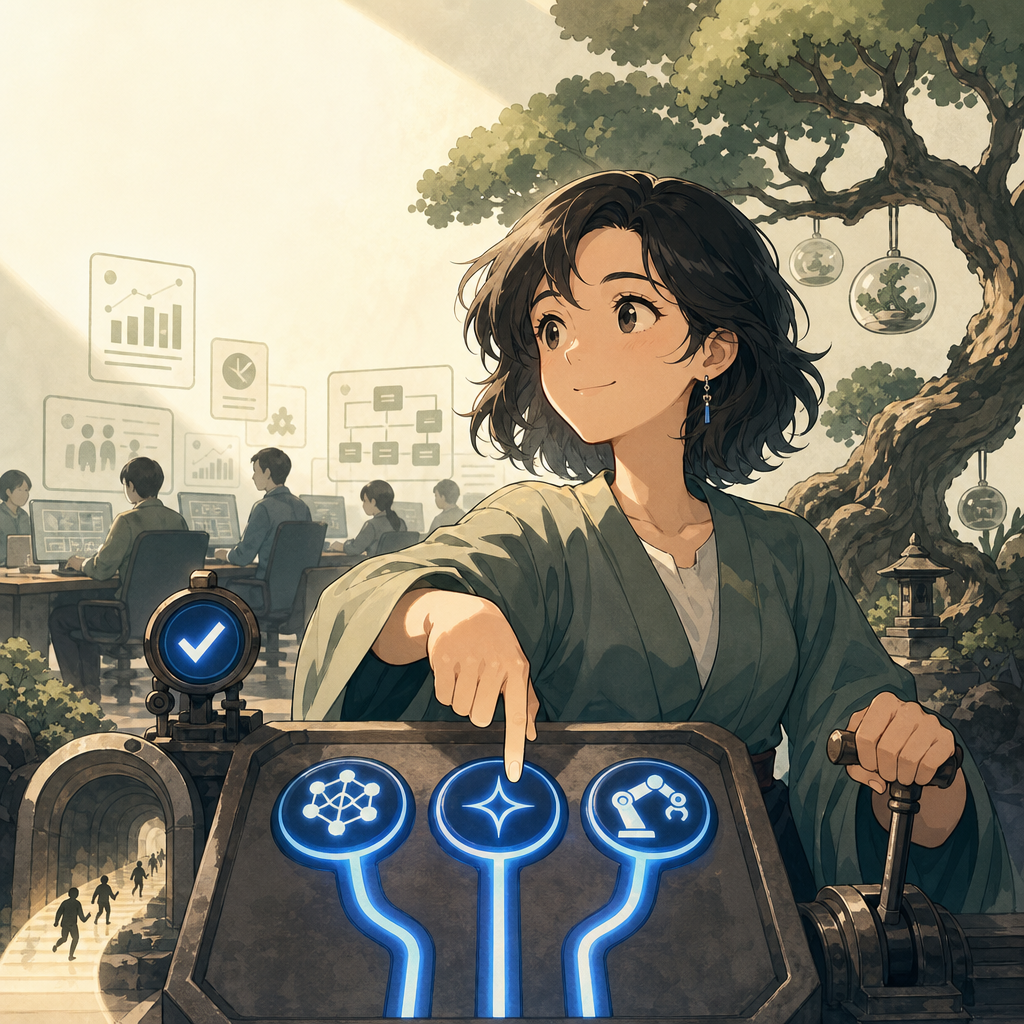
GPT-5.6 turns connected apps into finished work. The useful question is which tasks need Sol, Terra, Luna—or a human.


Via AI Data Insider: OpenAI Launches ChatGPT Work Powered by GPT-5.6 for Enterprise Workflows
AI agent governance matters because OpenAI's new ChatGPT Work can move across connected workplace applications and produce finished work. AI Data Insider reports that the agent can gather information from services including Slack, Microsoft Teams, Google Drive, SharePoint, email, calendars and customer relationship management systems. An SME owner should care because one delegated task can now cross several information boundaries before breakfast.
The July 14, 2026 launch pairs that connected agent with three GPT-5.6 tiers. Sol is presented as the flagship model, Terra as a lower-cost production option, and Luna as the fastest, cheapest member of the family. The source reports API prices per million input and output tokens of $5 and $30 for Sol, $2.50 and $15 for Terra, and $1 and $6 for Luna.
That is not merely a model leaderboard with nicer stationery. It creates an operating decision for each workflow: how much capability does the task need, what access should it receive, what must a person approve, and what happens if the chosen model, connector or price changes?
OpenAI is the vendor at the center of this launch, but the decision framework should remain vendor-neutral. The useful product is not loyalty to the strongest model. It is reliable work at an acceptable cost and risk, with a fallback that keeps the business moving.
The launch combines broad access, long-running tasks and recurring automation in one work surface. AI Data Insider says ChatGPT Work can create documents, spreadsheets, presentations and web applications, and can continue complex projects for hours with limited user intervention.
The source also describes Scheduled Tasks that can review Slack updates, monitor websites, summarize changes, refresh presentations from email feedback and update meeting agendas. A built-in browser can reach websites, online tools and files from Google Workspace and Microsoft 365, while expanded computer-use features can interact with local applications, browsers and files in the background.
Each capability may be useful. Together, they enlarge the area that one instruction can touch. An assistant that only drafts text presents one sort of risk. An agent that reads team messages, opens files, updates a presentation and repeats the process next Tuesday presents an operational chain. If the output is wrong, the relevant question is not only which model answered; it is which systems supplied context, which actions ran and which checkpoint should have caught the problem.
AI Data Insider reports that ChatGPT Work includes administrator controls for plugin access, connected tools, browser permissions and workspace policies, plus an Auto-review system for important actions involving tools and APIs. Those controls are useful ingredients, not self-executing governance. Someone still has to configure them, match them to the workflow and review whether the resulting process pays for itself.

A sensible rollout defines the workflow first and chooses the model second. Six decisions turn a product demo into an operating process rather than an expensive scavenger hunt through permissions.
Start with one bounded workflow and a reversible action set. A successful pilot should prove that the process is useful, controlled and measurable. Only then should access or autonomy expand. Capability is an invitation to design the operating model, not a coupon for skipping it.
“ChatGPT Work is an agent in ChatGPT that helps you take on more ambitious tasks.” — OpenAI
Managed AI Operations turns a connected agent from a one-off deployment into an owned business process. AgentsROI monitors quality, exceptions, costs, access, vendor changes and workflow results so the system does not quietly decay after the demo.
Model Selection & Continuity Planning supports that operating layer. Sol, Terra and Luna provide explicit performance and price choices; the right route depends on the job, data, review burden and consequence. AgentsROI tests those trade-offs and documents a fallback rather than assuming the largest model belongs everywhere.
The work remains stack-agnostic. Another provider, a hybrid design or a manual checkpoint may fit a step better. That judgment matters when connectors, prices and models change while the business outcome stays the same.
The owner gets a plain-English view: what runs, what it costs, what it can reach, where people approve, how performance is measured and what happens when a component fails. That is the part that keeps paying the invoice.
The first question is not whether GPT-5.6 is capable. It is which bounded business process deserves connected access, what result matters, where a person approves and which cheaper or alternate route can do the job reliably.
AgentsROI can design that model-routing and continuity plan, then operate the workflow as vendors, access and costs change. The goal is a connected agent the owner can explain in plain English: what it does, what it touches, what it costs and how it stops.
This article summarizes publicly reported information and is for general informational purposes only. It does not constitute legal, tax, financial, investment, security, or compliance advice. AgentsROI.ai is not a law firm, accounting firm, or registered investment adviser. Facts, pricing, statistics, and product capabilities cited here reflect the sources listed at the time of writing and may change. Readers should verify current information independently and consult qualified professionals regarding obligations specific to their industry, jurisdiction, and circumstances—including applicable New York State and New York City requirements. AgentsROI.ai may have commercial relationships with vendors mentioned; where material, such relationships are disclosed. Nothing in this article is an endorsement of any specific AI product, model, or provider.